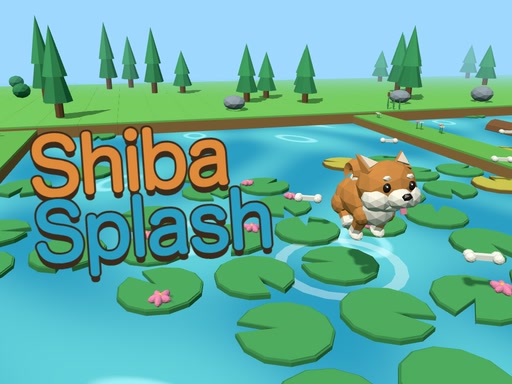
About Shiba Crossing
Watch one log go by
The dog in Shiba Crossing moves by hopping. If a floating log is passing in front of you, the spot it occupies when you begin the hop can be different from the spot it occupies when the dog lands. You can take the opening as soon as you see it, or watch a log go past first so you have a sense of how much room the movement leaves. The second option is useful when you are still learning what a single tap does.
The turtles and floating trunks make the crossing about timing as much as direction. It is natural to keep looking at the point right in front of the dog. The place you can go after the next hop is often more important. A route that gives you one easy jump and then leaves you with nowhere clear to go can be harder than a route that starts with a sideways move from the ground.
Two positions on the same moving trunk
**On the bank before the hop.** Watch one trunk cross the lane. If it is moving left, look for where its center will be by the time the next forward hop lands. A sideways hop on the bank can get the Shiba into line early. Wait for the center of the wood to reach that line, then hop forward. This avoids trying to solve the sideways part of the route while the dog is already crossing the water.
**On the trunk before the next hop.** The Shiba is now moving with the wood. Look at the next bank or trunk before hopping. If your target is offset, wait for the wood to carry you into a more useful line or make a side hop once another landing is visible. Choose the next forward hop before the trunk moves past the space you can reach. A successful first jump can give you a narrow second one if you land at the wrong end. Check the direction of the wood both times and use the bank to put the first hop on a cleaner line.
Read the traps at their own pace
Watch the turtle area before you move through it. Look at where an obstacle sits in relation to the approach. If you can take another position with a better view, use that spot before trying to push straight ahead. When a move fails, remember which part of it was difficult. A move that ended on the wrong location calls for a change in direction. A move that arrived a little too late calls for a different starting time. You can test those separately on the next attempt.
It can help to give yourself one small practice goal before working through the whole crossing. First, try to get the dog onto the first floating object from the bank and see where it carries you. Then practice the next intended move. Once you are comfortable making two connected hops, look at the section beyond them and find which of the previous choices leaves the best view of that stretch. The further you can see into the route, the less often you have to choose a direction after you are already in trouble.
Direction on a phone and direction on a keyboard
On desktop, WASD or the arrow keys let you hop in different directions. Space hops forward, P pauses and M mutes. On a phone, tap to hop ahead or swipe to move left, right or back. Make one input and watch where the dog goes before adding another. It is easy to think about the direction you want in the crossing and forget which gesture is going to move you there.
Learn the side and back hops in a part of the crossing with room to try them. They let you look for another route when the next place is blocked. A safe step to one side on the bank can make the same set of logs and turtles look like an entirely different set of choices.
Game credit on GameMonetize · GameGen