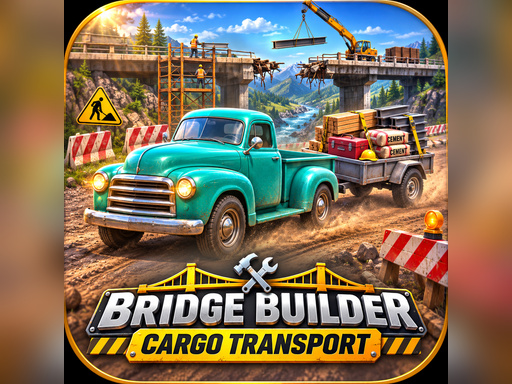
About Bridge Builder Cargo Transport
There are two vehicles to think about every time you turn in Bridge Builder Cargo Transport. The cab responds as soon as you steer. The trailer follows on a different line and has to bring the cement, steel or tools with it. This is a delivery job on the approaches to a damaged bridge. Bringing the whole shipment through the approach is what gives the drive its shape.
The corner your trailer takes
Picture a narrow road bending left. The front of the truck can fit through the bend before the rear has moved far enough to follow it. If you turn as soon as the cab draws level with the inside edge, the trailer can track across that edge. Give the cab enough room at the entrance and wait for the trailer to come through before you steer for the next change of direction. This matters more when two bends come close together and one correction carries into the next.
Use a part of the road with good visibility to check how the rig moves. A wide industrial route gives you more room to see what the truck and trailer are doing than a dusty approach with an obstacle close to the edge. Pick a marker in the scenery, turn slowly and notice when the trailer lines up behind you again. You can transfer that timing to a tighter route when the marker is the actual edge of the track.
Make the repair cargo the measure of the route
On a route with dirt followed by an industrial approach, use the start of the dirt to judge how the trailer moves with the load. Check the cargo after the first bump where you can still see it. If steel, tools or other repair materials are shifting close to an edge, slow before the second bump and keep the trailer lined up. Once you return to a firmer road, the cab may be ready to accelerate before the last axle of the trailer has cleared the rough ground. Give that axle a moment. A deadline matters only while the load can still reach the site.
An early run can serve as a survey with a completion target. Remember the first narrow ground, the last bump before the site and the place where the game asks you to bring the cargo. This particular job follows a load of construction materials to a damaged bridge. The last landmark is the repair destination, so keep the route in terms of what the loaded trailer can reach rather than treating an empty run in the cab as a successful rehearsal.
Work the delivery clock in sections
A deadline can tempt you to carry speed everywhere. Read the first part of the route for places where speed costs less attention. Straight industrial stretches can be a good opportunity to catch up. A single-lane approach with limited room to turn is a place where a shorter, slower input can save a longer correction.
If a delivery fails, name the section before you retry. Trouble at the same bend suggests you could enter at a different angle. Losing time while constantly braking and accelerating on easy stretches points to uneven pacing. A problem after a ridge suggests you turned while the trailer was still crossing. Each of those problems has a different solution. Try one change on the next run and use the same route to see its effect.
The handoff at the damaged bridge
When the repair site comes into view, work backward from the delivery target. Find a place where the trailer can follow the cab all the way to it. Use the last straight stretch to settle the load and approach the destination slowly enough to stop while the trailer is still lined up. If the cab reaches the marker but the game has not registered the delivery, look at the cargo and trailer position before driving farther. Bring the load fully into the indicated area if required by the current level. That is the moment to compare with your previous trip: repair cargo arrived, the trailer is in position and the game acknowledges the handoff. A fast approach to the marker is only useful if the materials make it there.
Game credit on GameMonetize · CozyFox