About FireBreak
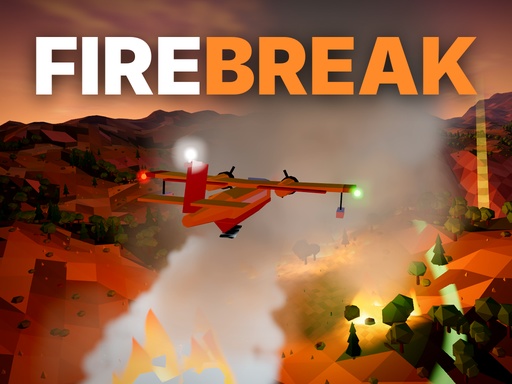
From above the fire, an orange patch near the edge can look like an easy place to drop a little water. Look past it for what might burn next. In FireBreak, a line of flames reaching unburnt ground can matter more than the brighter center, especially if a refill will take you away for a while. Decide where you hope to slow the spread before lining up the aircraft. You have time to do that as you leave the lake with a full tank, and your first approach will be easier if you’ve already picked the part of the fire you want to reach.
Fill, climb and set up a single pass
Choose a straight stretch of water with open space at the end. Fly a shallow approach and use the time over water to settle the plane. Hold E to scoop. If your arrival is so steep that you’re still trying to recover as you reach the surface, go around and start the descent farther back. A refill that leaves you climbing in roughly the direction you want gives you more time to look at the fire. After the climb, clear nearby terrain before you turn. In a narrow area, work out whether the next turn puts you toward a slope or toward open water before you bank.
Make your first drop along a section you can follow all the way through. A small patch along the edge may call for a tap of Space; holding Space commits more of the load when the target extends along your flight line. Begin the drop while you can see the line you’re trying to cover and watch where the water ends up. If the patch survives behind your plane, try beginning a little earlier on the next pass. If it survives on the other side, the approach angle also needs attention. Change one part of the flight rather than increasing the load every time a narrow placement misses.
Example route over an alpine lake or a canyon
Suppose the lake lies off to the left of a fire on a rising slope. You could climb over water, take a wide turn in open space and make a pass along the accessible edge of the fire. Compare that with crossing the slope low and trying to swing back sharply toward the lake. The wide turn takes room but gives you time to set up the drop. The low turn can force you to spend much of the approach watching the terrain. Use the first pass to check the route and protect a reachable portion. If more fire appears while you refill, concentrate on the end of the line that can reach fresh ground before you return.
When a different aircraft earns its place
A faster plane is useful when the refill and drop points are separated by a long stretch you can fly smoothly. Plan its turns farther away from the target and give the aircraft room after every drop. A helitanker can hover, making it a candidate for a smaller target where you can spend time placing water. Compare both by counting the useful drops you make during a mission, including the time to reload and travel back. A quick refill followed by a hard turn and a poor drop can be less effective than a longer flight with clear coverage.
Missions include desert canyons, alpine lakes, coastal hills and named regions such as Cinder Gulch, Ember Isle and Tallgrass Prairie. Changes in terrain and lighting affect what you can see on a run. Stars and credits give you reasons to try other aircraft and upgrades. Before you buy, notice whether the hard part was the flight back to water, the approach to the fire or the placement of the drop. An aircraft that helps your hardest part of the mission has a clear job.
W/S or Up/Down control climb and descent; A/D or Left/Right bank. Shift boosts and Q slows the aircraft. Hold E to scoop, then tap or hold Space to release water. Drag the mouse to look. Escape or P pauses. Learn the scoop and a single short drop in open terrain before asking yourself to combine them with a low turn.
Game credit on GameMonetize · JBizzle