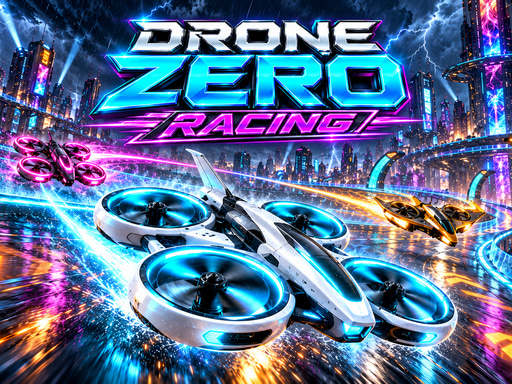
About DRONE ZERO RACING
Night in Drone Zero Racing has more than one racing line. You can follow the track through a tunnel, aim at a turbo ring floating above part of the course or stay low enough to catch a boost pad. Each option puts you into the approach to the next corner at a different height or speed. The drone gives you airbrakes, so you have something to do when a fast exit would put you too close to the wall of a tunnel.
Pair a tunnel approach with a ring exit
On one of the city courses with a tunnel and a turbo ring, use the ring as a marker for the approach you want to practice. Fly into the ring only when its exit leaves enough track for the drone to change direction toward the tunnel. Watch which side of the opening the drone is moving toward after the boost. If it continues sideways toward a wall, use the appropriate airbrake with Q or E and release it when the nose lines up with the way through. A short airbrake after lining up is easier to compare with a long input made when you are already at the tunnel wall. On another lap, take the pad or low track where it is available and compare how much correction you needed at the same opening.
Use Time Trial to see where the ghost begins to gain. An attractive ring has little value when the correction after it costs all the speed. In an event with seven rivals, watch whether another drone is already across the line that brought you out of the tunnel. The goals here are course time and racing position. Use the ring, track boost pad and airbrake for those purposes rather than reading the course like an aerial combat arena.
Try a clean lap before putting seven rivals in it
Time Trial gives you a ghost to compare against. On one lap, aim to hit the ring on the straight. On another, take a cleaner corner beforehand even if it means missing the ring. Compare which route puts you ahead by the next part of the track. The boost can look like the advantage on the screen before you find out how much time it will take to slow for the next turn. The ghost gives you a view of that effect when the race is still easy to read.
Use Q or E to learn the airbrakes on a corner with room for a small adjustment. Try one press a little sooner than feels necessary, then notice the line you get out of the turn. Decide whether you need the faster approach or the shorter turn. After a few laps you can make that decision from the approach and have the right key ready instead of looking for it once you have already passed the corner.
Spend credits on the difference you can see
Ten tracks open as you finish in the top three. Credits can buy any of eight drones as you progress and pay for improvements in the hangar. Take a new drone through a track you have already unlocked and see how it responds before and after using the airbrake. If your usual difficulty is moving from one side of a tunnel to the other, that’s a better test than a long open run where the drone mostly goes straight. If rivals are taking several boost areas that you cannot reach from your usual line, see which approach would let you use one more of them.
A night course can make a familiar maneuver feel less certain because you can see different parts of the track clearly. Reuse the cornering approach you practiced and choose a new thing to follow at the entrance. You have ten circuits to work through. Understanding one safe way to reach a ring is a skill you can use even if the next circuit positions the ring somewhere you did not expect.
Drone inputs
Use the arrow keys or WASD to steer and accelerate. Q/E control the airbrakes, Space activates turbo, V changes camera and Esc pauses. Mobile players have touch buttons. Try camera switching on a known straight so you can decide which view helps you see the height of the next gate.
Developer Mapi Games.