About COLD IMPACT: Rocket Missions
The flight begins at the launcher and changes again at the water
COLD IMPACT: Rocket Missions follows a rocket through a destructible arcade world. Your opening job is to charge the launch and get into the air. The first level takes you over ground and airborne targets, then toward a boss. The second lets you dive and fly again, so the next successful launch will eventually bring you to a different control problem. Coins from runs can improve the rocket, the launcher and the cargo. The important thing is to notice which part of a short run actually limited you.
Hold Space at the launcher and release to take off. Once in flight, watch where the nose points relative to the route you want through the scene. A small steering move while you are still high enough to see an open area can give you more useful distance than a sudden one after a target fills the screen. Before spending boost, decide what the extra distance will take you toward. Use Space in flight for boost, and steer with the arrows, WASD or ZQSD.
When the world is part of the target list
The destructible route includes tanks, helicopters and bridges. It can be more useful to aim through a portion of the scene than to steer at every target you see. If you are descending toward a bridge with another group visible beyond it, think about what direction the rocket will be pointing after the first contact. That tells you whether to keep the same line or use your control to reach another part of the level. A successful hit can still spoil your route if you chose it without knowing where you wanted to go afterward.
Save a familiar opening run as a test. On one flight, travel through the first target area at a quiet pace and keep the next bit of the route in view. On the next, use boost somewhere along the same line. If it carries you through farther, note where you pressed it. If you go past the part you wanted to hit and then spend the rest of the flight turning back toward it, use the boost later or pick a point where you can see a longer route.
Try the air-to-water transition separately from launch timing
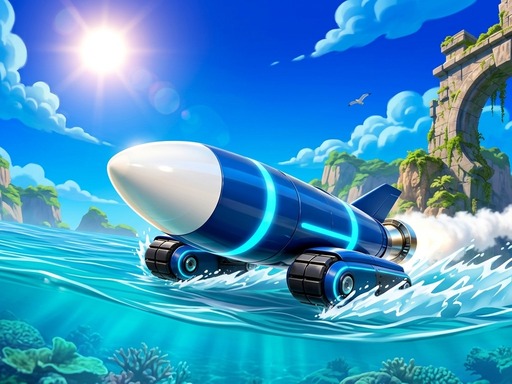
Use the amphibious second level to compare two different jobs for Space. At the launcher, hold the key to charge and release to begin the flight. Once the rocket is moving through the level, holding Space is a boost. Pick a launch you can repeat and avoid changing its timing while learning the dive. Look at the place where the air route meets the water. Make your first descent where the rocket has room for you to see how it continues below the surface. Use a short steer to see how the nose responds before committing more boost.
On the next run, approach the water from that same line and look for the point where you can begin climbing back out. Once the rocket rises into air again, check whether you still have a useful heading for the next target. The first level offers tanks, helicopters and a boss without that same dive-and-climb problem. If you struggle to clear the water transition after a good launch, comparing wings or an in-flight upgrade makes more sense than adjusting the launcher for every attempt. If the opening launch itself is short, compare it before spending on the climb.
When a small target stops being the most important thing
The big Titans and boss encounters give you larger objects to watch. Look at the part of the scene that contains the boss before you steer into it. Decide where you can control the rocket while still seeing what is ahead. Giving yourself an open approach helps when the route moves from several scattered targets to one main obstacle. You can get used to that switch by leaving a smaller target behind once you can see what the next encounter needs from you.
The amphibious stage changes the sightlines. Choose where you want to enter the water so you have a direction to follow underneath. When it is time to fly again, look for a route that gives you room to come out and steer. The abyssal sea boss belongs to that second part. Practice recognizing the point where an underwater approach gives way to the next climb rather than treating the dive as the end of a launch.
Let a weak run tell you what to improve
Wings, reactor and turbo belong to the rocket. The launcher and cargo have their own upgrades. When launches repeatedly feel short from the outset, check your charge timing and compare the launcher. When the route starts well and you lose control later, look at what the wings do to a steering move on a familiar flight. Look at reactor or turbo options when distance or your use of boost is the problem you keep noticing. Try a new part on a launch you already know before judging it on the water level.
A chest becomes available after several flights and can add to what you earned along the route. Use the next few flights to test one movement rather than doing the same run only for the coins. Arriving a little farther along the same line tells you whether to practice the launch, change an upgrade or use boost at a different moment.
Developer PCCODE.