About Castle Crashers: Stolen Sun
Choose a knight for the stage you actually want to explore
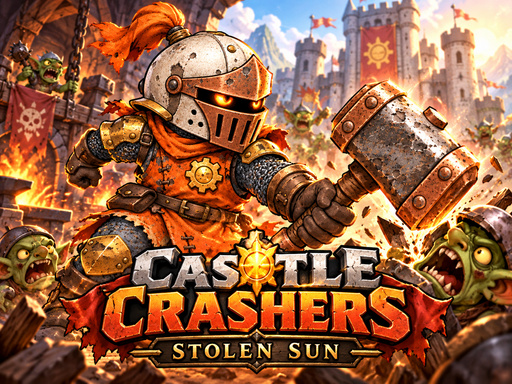
Castle Crashers: Stolen Sun is a 2D fantasy brawler set in a kingdom that has lost its daylight. Choose an elemental knight and work through 36 story stages with battles, optional paths and checkpoints. A stage can give you an obvious route to the exit and another way to look for salvage or explore. Decide which of those goals you want before passing the place where the paths divide. The game gives the same controls to a quick stage clear and a trip that investigates more of the kingdom.
Begin with a quiet place to see how your knight moves. Use WASD or the arrows to travel and Space to jump. Try a short jump toward an edge you can see and watch where you land. When an enemy comes into the scene, consider whether you will strike from there or shift to a place where you can watch the next part of the path. It is easier to learn where each action fits if the first attempt has one purpose at a time.
See what the knight’s element does before comparing equipment
Use J or left click for a strike combo. K or right click activates the elemental skill. Try the skill when the enemy and the space beside it are both visible. Look at the effect and how much movement you have available afterward. A regular strike can be enough for the immediate action. An elemental skill gives you another option when you can see what you want to do with it. Keep the two inputs separate when you practice so you can recognize which one produced the effect.
Salvage goes into improving tools and armor. Use the journey through a stage to decide what you want to change. A stage with a particular group of enemies can be a good place to repeat with another setup. A familiar optional route is useful when you want to see how the same knight feels with an improvement. Notice whether your original difficulty is still in the route or whether the change gives you more room to focus on what comes after it.
Choose an elemental knight and test the branch at a red lever
Select an elemental knight and read the skill the current build shows for that character. In an early stage where the main path and another route are both visible, clear the guards in the area and look for a red lever. Note which door or passage is closed before approaching it. Use the game’s strike or interaction on the lever as indicated, then look at which part of the stage has changed. An optional route can be worth exploring when it reveals a new path or salvage before the next stage. Return to the main exit after you see what the branch offers.
Try the same idea with a different knight only after you can recognize the lever area. Use the chosen skill when it can change how you reach the lever or get past the enemies beside it. Check the result rather than assuming every knight’s element opens the same thing. The skill belongs to the character. The lever is a separate stage clue, and the visible response tells you where to go next.
Read a boss encounter once before trying to finish it
Look at where the boss appears and which positions the game gives you to move after an attack. Try moving or jumping through a short part of the scene when you can see where the knight will land. Watch the effect of a skill from that position before using it again. A first attempt can be useful because it shows which movement was harder to read. On a replay, recognize that point sooner and decide whether a strike, movement or skill makes sense then.
On mobile, use the movement, Jump, Skill and Strike buttons. Esc/P opens options on keyboard, and M mutes. Progress continues between stages. When returning to the story, think about one unresolved detail instead of revisiting every optional branch. A lever you need to find, a different elemental move or a short route to an exit gives the next stage a reason to play differently.
Game credit on GameMonetize · BestCrazyGames