About TideRoll: Block Puzzle
The wooden block has two shapes on the same board
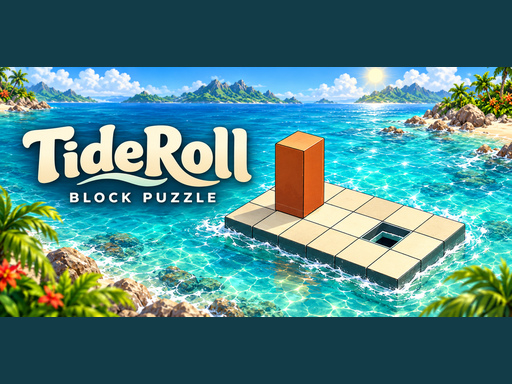
In TideRoll: Block Puzzle, the block rests across two tiles when it lies flat and occupies one when it stands upright. It must enter the goal hole upright. The floating boards give you switches, bridges and fragile orange tiles to work around. An orange tile supports the block when it is flat and breaks under an upright block. Checking how the block will come to rest after the next roll is part of every move.
Start on a stretch with room to roll the block both ways. Make one move and see which cells it takes up. When it stands, imagine the next roll as laying the block into the two cells ahead. When it lies lengthwise along the movement, rolling past its end brings it upright. A sideways roll changes the set of tiles under it in a different way. Use the first board to recognize those differences while you can still undo and try a second direction.
Think backward from the hole
Find the goal and look at the tiles beside it. Choose a direction from which you could roll the block upright into the opening. Imagine it flat in the two spaces that would make that final roll possible. Check whether the actual board provides enough room for that setup. A path close to the hole may leave you on the wrong orientation. A short trip around one side can put the long end of the block back where you wanted it.
Suppose you arrive with the block lying sideways beside the hole. Before trying the last move, check what the roll would cover. If you need to turn the orientation, look for a wider part of the platform where you have more directions you can use. Work out one small loop and then look at the hole again. You have a better chance of finishing when you plan around the last two tile positions instead of steering only toward the closest edge of the goal.
Orange is usable only with the right orientation
| Block movement | Landing state | What to check on orange |
|---|---|---|
| One roll from upright | The block settles across two squares. | Use a route with both squares supported and the orange tile under the flat block. |
| A second roll in the same direction | The block stands on one square. | Orange breaks under an upright block. Plan a different square to take that weight. |
| Final roll to the goal | The block needs to stand. | Use a supported approach that puts the upright block on the goal itself. |
Picture an upright block on A and the next cells labeled B, C and D. The first roll puts it flat across B and C. The second stands it on D. An orange B or C can form part of that flat crossing while the other cell supports the rest of the block. An orange D is unsafe because that is where the block stands. Choose a route that changes the upright landing, or approach the goal from another direction. In TideRoll, orange can look like a perfectly usable surface while planning. You still need to read the orientation it will receive.
Undo to isolate an orientation problem
If a move leaves the block unable to continue, use undo and look at the last flat or standing position you had. Decide whether the problem was lack of space or the direction of the block. A move on a wider section can let you approach the same tiles with a different orientation. If the board has a switch, check whether the path available after it changes gives you a new position from which to make that adjustment.
The game has 150 levels with sunny, rainy and snowy scenery. Look for support tiles and orientation before making a roll, even when a new background makes familiar colors look different. Use WASD or the arrow keys to roll the block. On mobile, tap the directional buttons. Before the last move, name the two tiles the block sits on now and the one it should stand on afterward. That check can resolve a puzzle that looks finished except for the final turn.