About Trust Issues: Lying Signs
Treat a sign as a question left by the designer
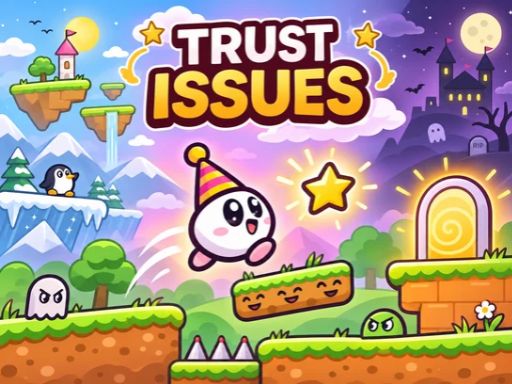
The first thing you learn in Trust Issues: Lying Signs is that a direction on a board can be part of the trap. A place marked safe can have spikes. A sign about needing no key can be a reason to look for the key. Even the door at the end of a run deserves a quick look. The text gives you a clue to what the level wants you to notice, and the title tells you how much trust to put in that clue.
The joke works because the basic controls are familiar. Move left or right with the arrow keys or A/D. Jump with Space, W or Up Arrow. Once you know those inputs, the level can make an ordinary-looking jump feel like a choice. Read the ground, the opening and any object close to it while you decide what a safe first movement would be. If there is an easy way to pause before committing, use it to see what the sign is inviting you to miss.
Test the sign that says “No key needed”
When you see a sign claiming no key is needed, stop before committing to the door. Look for an area you can still inspect without crossing into another room. From the same start, try reaching the door once and watch how reaching it differs from finishing the level. If it stays closed or the route leads nowhere, return to the closest point where you can still choose another direction. Look in the space the sign encouraged you to skip. Go back to the door after finding the key rather than testing unrelated corners of the stage.
This is one of the game’s documented reversals. Use it as a method for later signs without assuming they all require a key. State the claim, pick the smallest action that can check it, and watch which part of the room proves it wrong. On desktop, R lets you restart a failed test. When you have a way back, use it instead of resetting immediately. That preserves the position that made the false claim visible and makes it easier to compare the next attempt.
Keep a trial separate from the run you want to finish
When you are learning a stage, observe where cannons, saws and enemies change the path. On one attempt, look at the first odd movement and see how it reacts to your arrival. On the next, use what you saw and bring it into the longer route. If you change both where you jump and when you jump at the same time, you may get through without learning which choice worked. Try a single adjustment where the last attempt keeps ending.
Stars, coins and skins give you things to work toward beyond the exit. On an unfamiliar level, a clean finish teaches you the route. On a replay, look for a star from that route and work out the way back before taking it. A collectible can make you walk into the lesson a sign was trying to teach you, even when you already know where the direct route goes. Work out whether the extra jump is one you can trace both ways.
Use the hint to learn what you missed
There are 25 levels across several worlds. A new world can take an idea you recognize and give it another place to hide. Press H for a hint when you have checked the obvious options and still cannot see what the game is doing. Compare the hint with the part of the layout you did not look at. It may help you see the difference between an instruction that is clearly false and a clue that is true only in a very narrow sense.
Press R to restart or P/Esc to pause. On mobile, use the arrow buttons to move and Jump to leave the ground. When the next sign comes into view, see which feature of the level it is trying to make you take for granted, then check that feature before following the road under it.
Developer Afzaal Games.